[Source](https://rubenlaukkonen.substack.com/p/multiscale-causality-and-the-meaning?utm_source=post-email-title&publication_id=1827525&post_id=185795610&utm_campaign=email-post-title&isFreemail=true&r=99ka&triedRedirect=true&utm_medium=email)
### How to surf the cosmic gradient to improve your life
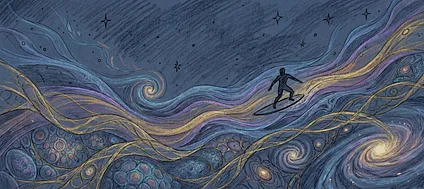
In this article, I argue that meaning, purpose, path, and synchronicity, are a cluster of basic human experiences that we *receive* when the channel between part and whole is open. They are top-down signals about what is “good” in light of the broader reality you are embedded in.
I will call these signals *metacognitive gradients*. As we will see, it all falls out of the mathematics and biology of embedded cognition.
**The logic is pretty simple:**
1. The meaning crisis is, at root, a breakdown in cross-scale coupling—i.e., being out of synchrony with higher scales of causality beyond the isolated individual.
2. Higher scales cannot be compressed into the local mind because the effective complexity of the larger system exceeds the modelling capacity of the smaller agent.
3. Therefore, the only sustainable way an embedded organism can relate to higher-order patterns is through calibrated openness or permeability; what I will call *faith*.
### Everything is nested
It all begins with the observation that *everything we observe in nature is embedded.* Cells are embedded in organs. Organs are embedded in organisms. Organisms are embedded in ecosystems. Ecosystems are embedded in biospheres. At every level, the part depends on the whole for its existence and function.
It is therefore with exceptionally strong interdisciplinary evidence that we can predict that we are also part of larger interdependent wholes with causal power over our lives.
Plants and animals would not survive were they not in harmony with the dynamics of the forest. The context of the forest is always “speaking” to its parts (the top-down signal) through temperature gradients, seasonal rhythms, and ecological pressures.
The collective ephaptic fields in the brain synchronise neurons to generate a state of “meaning” beyond single action potentials. Cells don’t know where to grow or replicate without being in tune with the global program of the body. And without the chemical gradients carved out by the prerogative of the higher-order, homeostatic pattern, disease ensues.
Extending these premises (cf. Levin; Vervaeke), I propose that the meaning crisis is driven by a disconnection from the umbilical cord that connects us to causal patterns of order larger than our selves. Meaning is the phenomenological signature of a top-down constraint.
Just like the neuron depends upon the rest of the brain for meaningful action potentials, we depend upon these higher order signals in order to truly flourish. By analogy, we experience as meaning what the neuron “experiences” as abundant energy, or ease of firing, in light of coherence with surrounding oscillations.
### Meaning as a metacognitive gradient
Meaning can be understood as a *metacognitive gradient*. Why “metacognitive” and why “gradient”?
First, meaning is not an object-level inference (like seeing a chair, or smelling a rose). It is *about* cognition (i.e., meta). It is a higher-order, felt signal that guides how an agent ought to allocate attention, effort, and action under conditions of irreducible uncertainty over long horizons.
Calling meaning a *gradient* is also deliberate.
Gradients allow local navigation without global knowledge. A bacterium does not need a map of its environment to survive; it follows chemical gradients. A neuron does not need a theory of the brain; it entrains to local fields. Likewise, a human agent embedded in systems vastly more complex cannot compute the optimal life path.
Specifically, meaning is a metacognitive experience of the felt slope of increasing coherence between a local agent and the larger systems it is embedded in. When action increases alignment with higher-order constraints, meaning intensifies. When action decreases alignment, meaning flattens.
Many intriguing questions arise:
How should a far smaller and simpler channel relate to a much larger, more complex, network? How do we relate to causal patterns that transcend us? What is specifically blocking sensitivity to the meaning gradient?
### The irreducibility of faith
Here’s the core issue.
*The larger system’s complexity exceeds your modeling capacity.* Therefore, you cannot—in principle, not just in practice—represent the whole of which you are a part. You cannot *know* what’s going on “above” in a definitive way. Orientation therefore requires trust in partly opaque constraints.
Because the causal web that generates your life is vastly higher-dimensional than your local model of it, no bounded agent can fully derive the correct action from first principles. So the agent is forced to rely on something beyond complete understanding.
A red blood cell cannot model the circulatory system. It lacks the computational bandwidth. It has no representation of heart or lung or exercise. It simply responds to local chemical gradients of oxygen and carbon dioxide (and other stuff it does not at all comprehend). It must therefore “trust” and orient to patterns it cannot fully decode.
In other words, relating to higher causal patterns demands *faith*: a calibrated receptivity to top-down constraint under irreducible uncertainty.
Or more simply, faith is action guided by the ineffable.
*We can put this in another way:*
Faith is irreducible because embedding is irreducible. There’s no way to model the future of a thing without understanding the causal forces within which it is embedded (and within which *that* layer is embedded, etc.) leading to a combinatorial explosion.
Obviously, you can still do science because “carving nature at its joints”, or finding pockets of reducibility (cf. Wolfram), works. But at the lived level of an organism navigating through their personal reality, it breaks down. There is no scientific theory that helps *you* personally choose a partner, to decide on a career, or a mechanism to feel more aligned with your purpose, meaning, and path.
**\[NB: I have approached a formal argument at the end of the article\]**
### The art of permeability
One thing that unites all of our ancestors is the fact that they were all believers in a larger hierarchy of being, of which they were not the highest authority or power. From the Lords of Valhalla to Zeus, Vishnu, Christ, Allah, Prometheus, and the nature spirits and God’s of all infinite forms, these hierarchies and our relationships to them were the stable source of meaning, purpose, and authority; the one thing even kings could not overstep, albeit at their peril.
Of course, the form given to the gods is by necessity illusory even if it’s functional. The shapes ascribed to higher-order patterns are always false shapes. Denying the specific nature, names, and forms of these figures is one thing, but denying the existence of larger organising forces is an immensely costly illusion that betrays all evidence of multi-scale causality.
**Hence the flip side:**
*The meaning crisis is a problem of hubris.*
It is the mistaken belief that the part should be epistemically sovereign over the whole. It is the futile attempt to squeeze a universe into a brain. It is the arrogance of putting oneself above “god(s)”.
And blinded by pride, we lose our north star.
We no longer feel the ocean that pushes and pulls the waves. We are still being pushed and pulled, only we are in a state of resistance, incoherently wasting energy and resources because we fail to listen to the vast sound of the universe to which we belong, hopelessly swimming against the riptide.
We end up feeling homeless, afraid, alone, while treading water in abundance. We end up impermeable to the cognitive nutrients we need from the larger whole. The ant wanders away from its colony and cooks in the sun. The cell becomes cancerous—disregulated, disintegrated, out of touch, multiplying in the direction of its own destruction.
You see: it’s all already right there in our phenomenology!
We don’t evolve to have universal sensations and cognitions without reason. Ignoring these signals is as silly as ignoring your sense of taste, smell, sight, justice, or direction.
*Only you will not be able to explain it.*
Conscious faith is reason: Reason tells you you’re bounded. Reason tells you you’re embedded. Reason tells you you cannot compute the whole. And therefore reason implies faith: the calibrated openness to the whole. The question is never whether you will live by faith. The question is whether you will do it unconsciously (scattered, defensive, incoherent) or consciously, with humility, in relationship to the larger field.
This is why the ancient intuition of “a higher hierarchy of being” keeps reappearing. Our ancestors weren’t stupid. They just projected a little too much. *The Dao that can be spoken is not...*
### Conclusion
When we lack meaning we lose the basic capacity to relate to the cosmos. We become unmoored from the whole. The world becomes flat and grey. Life becomes a selfish optimisation problem with no objective function that feels genuinely important and uniquely for us.
The sacred becomes embarrassing.
It is because we’ve lost touch with the *golden thread*: a key metacognitive gradient that reveals the right path. Faith is the reopening of that channel. The recognition that the most rational thing a bounded agent can do is remain permeable to signals from beyond its boundary.
**Here’s some prompts that might help set things straight:**
*Recognise* that you are not an isolated mind in a dead universe. You are a node in nested systems of staggering complexity. Your existence depends on these systems. Meaning flows from them. *Humble yourself:*Your beliefs are useful but incomplete. Your priors are effectively empty. Hold them firmly enough to act, loosely enough to learn.
*Bow to the ineffable upon which your existence rests.*
*Pay attention* to signals of meaning, calling, synchronicity, the sense of the sacred. These are information. Treat them the same as you would treat the aroma of a rose. They are the felt sense of alignment with larger patterns. *Surrender* to the recognition that your local optimisation needs to yield to larger constraints. Let thy will, be mine.
Orient towards broader and broader scopes of care. Boundless compassion may be one of the few active ways of making us more coherent with larger forces. Compassion is the alignment hack.
Ultimately, re-learning to surf universal, cosmic gradients and re-discovering the golden threads of flourishing demands a humble willingness to listen to forces that we do not understand.
Thanks for reading,
Much love,
Ruben
PS - I have prioritised in writing this blog post “getting the point across”, thereby avoiding lots of useful caveats and allowing myself permission to oversimplify analogies to the brain, body, and biology (but hopefully not too much). I do, however, believe that this is a genuinely tractable viewpoint that can lead to new scientific hypotheses. For me it already has, but more on that later. '
### Approaching a formal argument
**Let:**
- ***S*** be the larger system (e.g., a culture, an ecosystem, an economy, a biosphere, the Dao—call it “the whole”).
- ***A*** be an agent embedded within it (e.g., you).
- ***K(S)*** be the effective Kolmogorov complexity of ***S*** —the minimal description length required to reproduce its behaviour to a useful degree (here used as a principled proxy for irreducible compressibility).
- ***R(A)*** be the agent’s finite modelling resources: energy requirements, compute, memory, data access, attention, time, and algorithmic ingenuity.
Then, in the regime where: **K(S) > R(A)** the agent cannot fully derive the “right action” from complete understanding of ***S***. Any attempt to fully justify action from first principles would require internalising the relevant causal structure of the whole, which is too large.
Also, I’m not a mathematician.