[Source](https://contraptions.venkateshrao.com/p/every-story-is-a-degrowth-story?utm_source=post-email-title&publication_id=9973&post_id=157261450&utm_campaign=email-post-title&isFreemail=false&r=99ka&triedRedirect=true&utm_medium=email)
*For February, the [Contraptions Book club](https://contraptions.venkateshrao.com/p/contraptions-book-club) is reading **Raiders, Rulers, and Traders: The Horse and the Rise of Empires** by David Chaffetz, to be discussed the week of February 24. The [chat thread](https://open.substack.com/chat/posts/a014f812-0c76-431e-9da1-8d39643cdf62) is open for early comments.*
Three big, unmanaged forces of destruction and creation are irrupting into the human world across the planet today. The story of the permaweird over the next decade is going to be the story of these three entangled forces.
1. Internet-native nomad invasions (née: ethnonational reactionism)
2. AIs, particularly LLMs
3. Climate change
Fortunately for our sanity, the three forces are operating on different time-scales and in different parts of the world with different intensities. Like the villain’s henchmen coming at the hero one after the other rather than all at once, there is a certain helpful ordering here. Which is not to say the three forces are entirely serialized and decoupled. There will be significant episodes where 2/3 or even 3/3 of these forces will act together. Or appear in weirdly scrambled orders in particular scenes.
The nomad invasions — by political tribes around the world riding free-ranging internet denizens — are cued up to go first. Career politicians, operators, and their allies from business, the media, and the arts, are the equivalent of Mongols. The masses of internet supporters powering their campaign are the horses (though a surprisingly number of the horses imagine themselves to be riders). These invasions will peak over the next four years. The situation resembles the state of the world around the time of Genghis Khan’s grandsons, except there is no Genghis-like single progenitor. Trump is perhaps like Batu Khan, founder of the Golden Horde. Putin is perhaps like Hulegu Khan, founder of the Ilkhanate of Iran. Xi Jinpeng is perhaps like Kublai Khan, though I don’t think the Chinese state likes acknowledging the legacy of the Mongols or the “barbarian” strand of its imperial DNA. There are a great many other minor Khans around the world, such as Milei in Argentina and Meloni in Italy.
Most likely the world of these modern-day Chinggisids will continue through the next decade, but like that world, it will eventually collapse due to their inability to build new institutions designed to last. The story of the world so far has been the story of nomad invaders prevailing in the short term, but sedentary civilizations prevailing over the long term. Nothing about these latest invasions, from the internet steppes, suggests this will change.
AI is queued up to truly arrive next, as the next generation of powerful hardware lands, costs fall, and the action really heats up. The metaphor I’ve been developing for this is that of a succession of sharply demarcated geological strata of collective hive-mind intelligences and memory settling. Each stratum comprises a generation of foundation models, and the short-lived linguistic era it drives. In each stratum, humans co-evolve with the models of that vintage, creating a staircase of radical transhuman evolution. The basic assumption of this metaphor is that *language itself* is a humanity-scale uncompressed networked intelligence. Now LLMs just compress, archive and backup this latent intelligence periodically, with those archival intelligences being plugged back in to living language, helping drive the next epoch of co-evolution. The “intelligence” in AI isn’t in the computers or models. It’s in the self-reproducing training data. AIs and brains alike are merely data’s way of making more data.
I will develop these two analogies in detail in future posts, but for now I just wanted to share these trailers.
And finally, climate change will bring up the rear in this triad of forces. As yet, I have no good metaphor or mental model for it, but it will be a bigger force than either the internet nomad invasions or AI. The rising and increasingly volatile cost of coffee and cocoa in the coming year will be a small taste of what’s to come.
I predict that the whole drama will last about 10-15 years, so let’s pick a nice round unlucky number and say 13 years, which takes our horizon out to 2038. All three forces will be at work through the entire 13 years, but will peak at different times, at different loci, and have very different magnitude profiles across time and space. And the drama won’t end up with resolutions but with our collective arrival on a particular sort of threshold I’ll characterize in a minute.
People are trying to tell themselves a variety of different stories about the next 13 years based on how they’re making sense of them.
There’s only problem. If you look closely, *every* currently popular big-future story is a degrowth story, driven by some flavor of panicked, uncomprehending Everything, Everywhere, All At Once (EEAAO) FUD.
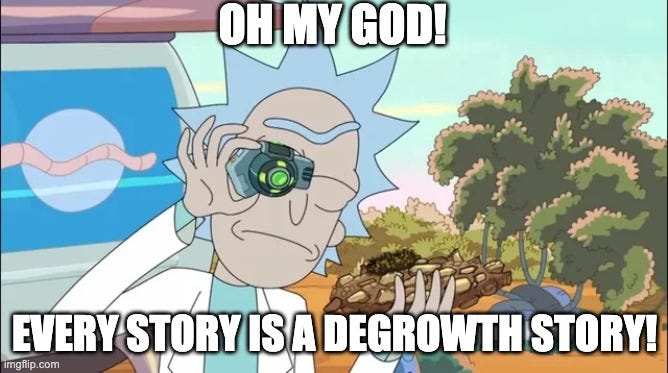
To escape the paranoid EEAAO style of storytelling the future, and tell better stories, we have to start with a revisionist telling of the OG story about a series of three monsters, each bigger and badder than the last, *Beowulf.*
Humanity is on the threshold of its *Beowulf* arc. The structure of the drama before us, and the prognosis for the next decade, can be found in the plot of *Beowulf*.
In the story, the hero Beowulf first battles the monster Grendel and prevails. Then he battles Grendel’s mother and prevails. Then he battles the dragon, and kills it, but is fatally injured himself in the process. The story ends on a gloomy note. Here is ChatGPT’s summary of the state of the world at the end of *Beowulf:*
> *In Beowulf, what is the state of the world foreshadowed and prefigured towards the end when the hero dies?*
>
> At the end of *Beowulf*, the poet hints at a world on the brink of decline—a shift from the heroic age of valor and order to an era marked by decay, vulnerability, and foreboding uncertainty. With Beowulf’s death, the protective spirit and martial prowess that had safeguarded his people vanish. His loss prefigures a future where:
>
> - **The End of an Era:** The heroic age is over, and with it, the values and strength that once defined society.
> - **Impending Insecurity:** The community is left exposed to external threats and internal disintegration, signaling a move towards a darker, less stable time.
> - **Loss of Unity and Hope:** The unity and moral clarity provided by heroic leadership give way to a more fragmented, less hopeful future.
>
> In sum, Beowulf’s death symbolizes not just the loss of a hero but the beginning of a more precarious world, where the remnants of past glory cannot stave off the inevitable decline and the challenges that lie ahead.
This is the traditional analysis of the story, as traditionally told, from the point of view of Beowulf and the centralized societies he protects. But the analysis would hang together even if you told the story from the point of view of Grendel, Grendel’s mother, or the dragon. These are four characters who each see themselves as the heroes of their own stories.
What ends with the tale is heroism as an ethos, and as a meaningful basis for running a world.
Good riddance. Heroism is a ridiculous basis for running a world. Main character energy is narrative fossil fuel.
Strangely enough, I find the end-state as described to be a *positive* state, on the threshold of an evolutionary leap to a vastly more interesting state that I think I’ll live long enough to see in the version playing out in our times.
==A world of, for, and by ordinary people rather than a world revolving around self-mythologizing heroes casting each other as monstrous villains. An antifragile world that isn’t artificially shielded from the real uncertainties of its environment through the costly false stability of the establishment *or* the false promises of charismatic anti-establishment mythologies. A world that isn’t bound to a single, unified *[there is no alternative](https://substack.com/home/post/p-157189054)* [“official future” narrative](https://substack.com/home/post/p-157189054) of (false) hope, or sophomoric illusions of moral clarity. A world of ordinary, mediocre adults dealing with the turbulent and morally ambiguous world as it is, as best they can, rather than through the lens of wishful visions and the exercise of fictive agencies. And doing so within an illegible, pluralist, divergent, polycentric governing narrative that is up to the task of matching the growing complexity and variety of the world.==
The nomad invaders from the internet hoping for a simpler world, and a return to simpler times when men were Real Men, women were Real Women, and small furry creatures from Alpha Centauri were Real Small Furry Creatures from Alpha Centauri, are going to be sorely disappointed.
The strong-statists, hoping for a world where a Ministry for the Future led by Great Bureaucrats prevails, are going to be equally disappointed.
And the AI cultists of all varieties are going to be the most disappointed of all. The world is too complex for either simplistic superintelligence dystopias or accelerationist utopias to be *the* story.
The *Beowulf* plot offers a bit of transitional narrative scaffolding to a state of heightened indeterminacy. It isn’t going to satisfy anybody’s grand-narrative tastes or meaning-hunger, but is still going to get us somewhere interesting.
This interesting condition is the slowly emerging state of the world that I’ve been calling *protocolized.* A protocolized world is one that is neither utopian, nor dystopian, and neither officially predetermined, nor entirely a wild and trackless end-of-history void. A world that accommodates many alternatives. Whose multi-threaded plot is advanced not by the workings of main-character energy, but by a *narrative protocol* (see the [protocol narrative](https://contraptions.venkateshrao.com/p/protocol-narratives) series I wrote in 2023). It will neither be a world of competing national exceptionalist narratives, nor one with a legible “international rules-based order.” Yet it will not be a state of chaos. Like the precursor microcosm that is today’s internet, the world at large will have a hidden protocolized structure, with a complex sort of thriving on top.
The reason I’m genuinely excited by the [Protocolized magazine project](https://protocolized.summerofprotocols.com/) (where I’ll be pursuing some of these trains of thought in greater detail, so you should subscribe) is that it envisions, and works towards, a more *complex* world, rather than trying to prevent a dystopia or catalyze a utopia. The world we’re headed towards will hopefully be fundamentally more complex than the one we’re in now, even if we have to endure some transitional simplification.
It is important to understand why increasing complexity is good, and increasing simplicity is bad, because all our favorite stories try to convince us the opposite is true.
Everything we know about civilizations tells us that there are no magic, bloodless leaps to utopian states featuring pure [[flourishing]]. Everything we know tells us that collapse is not about the failure of particular moral narratives, but about the complexity of the human world failing to keep with the growing complexity of its environment (wild, tamed, and built), transformed by technology and ambition. As Joseph Tainter’s book *The Collapse of Complex Societies* demonstrates, the danger is actually the loss of complexity itself. Collapsed states are *simpler* states, so anyone working towards a simpler state — and anyone telling an intelligible tale is doing precisely that — is working towards a collapse. The failure of a world begins with a failure of the imagination to comprehend increased complexity, and an urge to retreat to greater simplicity.
It’s fun and easy to make fun of “degrowthers” because they are the people doing this in the most on-the-nose way, but basically *anyone* telling a single-stranded story of the future that you can easily follow is effectively a degrowther.
- Paladin saves the world? Degrowth story.
- Barbarian masculine energy saves the world? Degrowth story.
- Enlightened sexless bureaucracy saves the world? Degrowth story.
- Nurturing feminine energy saves the world? Degrowth story.
- Unbridled technological acceleration saves the world? Degrowth story.
- Unbridled GDP growth saves the world? Degrowth story.
- Saintly moralist preacher saves the world? Degrowth story.
- Sovereign individualists clutching crypto wallets save the world? Degrowth story.
- Conspicuous Unconsumers literally trying to degrow? Degrowth story.
- Retvrn to \[insert your religion\] traditionalism saves the world? Degrowth story.
*It is only a growth story if you can’t narrate it ahead of time, and the only mechanism that can deliver that is one whose plot lines and outcomes you can’t predict in terms of preferred moral arcs or officially sanctioned futures.*
By the simplification-as-collapse theory, good futures, ones worth working for, are by definition going to be too complex to be legible before we’ve actually lived through them. If you tell your story in a powerful, inspiring, coherent way that millions resonate with, and cannot see in what way your story invisibly features degrowth and collapse, you’re missing something big. Probably something that you can only see via projection, smeared across all competing stories. Something that triggers panic and fear, which you have an urge to root out and destroy with extreme prejudice.
As [Gall’s Law](https://en.wikipedia.org/wiki/John_Gall_\(author\)#Gall's_law) suggests, you don’t get to a more complex society by mindlessly throwing away the steering wheel and flooring the accelerator on the current society once it’s on a heading you like. Nor do you get to it by slamming on the brakes and trying to solve for a mythical “sustainability.”
The way you get to more complex states of civilization is to level up the energy and resource base you can build on. But this isn’t a question of squeezing more “efficiency” out of the current resource base by making our cities, cars, and bureaucracies more “efficient.” That can at best buy some time. Nor is it about science-fictional [Kardashev scale](https://en.wikipedia.org/wiki/Kardashev_scale) leaps in harnessing energy overcoming Vaclav-Smil gloom-and-doom prognostications. Something like that is necessary, but nowhere near sufficient.
You get there by building a civilization that is organized in very different ways. Ways that derive not from utopian or dystopian visions, but different working principles.
Protocolization is one possible recipe for this. Protocolization is to the permaweird what institutionalization was to the industrial world.
We won’t get there bloodlessly, and it won’t feel either utopian or dystopian when we land on the threshold of *ever after* once more, around 2038. It will simply feel time has been rebooted. Like we have figured out how to continue playing. Like we have saved the [[infinite game]] from a fragile bottleneck phase that threatened to extinguish it entirely, because everyone was locked on to one terrible degrowth story or the other. Like there are horizons worth chasing after once again.
Right now, the future doesn’t exist because nobody can see past their preferred degrowth story. As James Carse might have put it, today there are no horizons, only boundaries.
So this is not going to be fun 13 years, but it’s not going to be entirely bleak either. Regardless of where you stand in relation to each of the three forces I’ve listed, there will be moments of cheer, and even entire chapters of cheer. In fact, the danger is not that the bleakness will kill you, but that the heady chapters of cheer will lead you into excess and overreach. Into limiting self-caricatures that drive you towards cartoonishly tragic fates. It will make for delicious *schadenfreude* when it happens to your adversaries, but not quite so much fun when it happens to you.
The overall story is not going to closely match anybody’s naive idea of “progress” or the “arc of the moral universe” bending towards their favored KPI (justice, manliness, human-centeredness, sovereign individualism, social democracy…). But for that very reason, it’s going to ultimately be good for all who survive it. Battle-tested versions of their favored stories, hopefully with heroes and villains cut down to fallible human size, will become part of the new soup of pluralism that’s cooking. And those stories will learn to get along within a hardened pluralism, without insisting on being the one true narrative to which there is no alternative. The world will learn to run on something other than main-character energy, just as it once learned to run on something other than belief in gods and magic.
Many people who *don’t* survive the Beowulf arc perhaps won’t deserve their fates by your moral calculus. Perhaps even by *all* moral calculi. There will be events that count as global consensus tragedies along the way. But there’s never been a bloodless and pleasant leveling up of the human condition in history. Metamorphic transformations of the world have never occurred without a thick strand of tragedy woven into the story.
You won’t always be in the story, something hero-types chasing main-character energy don’t get. When you *are* part of the story, you’ll most likely be a bit player and know it. Sometimes you may end up cast as hero or villain (likely both at once), but if you actually end up drunk on your 15 minutes of mythologization, that will be the beginning of the end of you.
The most useful fact to keep in mind is that while a great deal is happening, and while a lot of it is indeed already bloody and destructive, not everything is happening to everybody, everywhere, all the time. And in fact, there will be plenty of times when *nothing* is happening to you in particular, leaving you free to inject novel things into the story that make it less bleakly deterministic for all. How you use that freedom will help shape how our *Beowulf* arc ends, and what sort of *ever-after* threshold we land on around 2038.
This is why I’m lukewarm on the metamodern turn in the modern narrative arts. *Everything, everywhere, all at once* is the mantra of those terminally pwned by the FUD and VUCA of the world around us. People frozen into inaction because they think everything that’s happening is happening to *them*, right *now*, right *here*.
This is also why I reject frames like *polycrisis, permacrisis,* and *omnicrisis,* all of which have a paranoid but charismatic EEAAO quality to them. Instead I use the term *permaweird* (see my old essay, *[The Permaweird](https://contraptions.venkateshrao.com/p/the-permaweird)* for details, and more on competing frames). If you can’t even muster up enough situation awareness to break down what you’re seeing into smaller, more manageable chunks and threads, separated in time, space, and on the social graph, you’re not going to make it.
I’ve already mentioned one big way the permaweird is *not* EEAAO — the three big forces are not playing out on the same time scales and in the same places. There are many other ways, all the way down to the smallest events.
As [one of my favorite quotes about time goes](https://contraptions.venkateshrao.com/p/eventfulness), *time is nature’s way of making sure everything doesn’t happen at once.* When you insist on pretending otherwise, time might seem to end for you, but it actually goes on. Even for you.
And when something *does* happen to you, don’t be too quick to lock onto an interpretation and valuation. The Chinese fable, *[The old man lost his horse](https://en.wikipedia.org/wiki/The_old_man_lost_his_horse),* is a good way to understand things that happen to you over the next 13 years*.*
Is whatever just happened that has you marinading in EEAAO anxiety a bad thing?
*Maybe so, maybe not, we’ll see.*
Is whatever just happened that has you exulting in the ecstasy of validation of your ideas?
*Maybe so, maybe not, we’ll see.*